

Famciclovir vs Acyclovir: Which Antiviral Is Better for Herpes?

Nov 11, 2026

There is no single best antiviral for everyone. Famciclovir and acyclovir both treat herpes and shingles, and the right choice depends on the infection, your kidney function, pregnancy or breastfeeding, and the schedule your doctor prescribes.

If you have been diagnosed with herpes or shingles, your doctor may prescribe an antiviral such as famciclovir or acyclovir. Penvir is a prescription oral antiviral medicine containing famciclovir. Understanding its active ingredient can help you have a more informed conversation about your treatment.

Quick answer: which is better?

Both are established antivirals that interfere with herpesvirus multiplication and can help manage outbreaks. Neither cures herpes, because the virus stays dormant in nerve cells and can reactivate later. The medicine that suits you depends on

  • The infection being treated (genital herpes, cold sores or shingles).
  • Whether treatment is for a current outbreak or to reduce recurrences.
  • Kidney function and other medicines you take.
  • Pregnancy or breastfeeding.
  • The dosing schedule your doctor prescribes, and cost and availability.

The choice should always be made by a qualified healthcare professional.
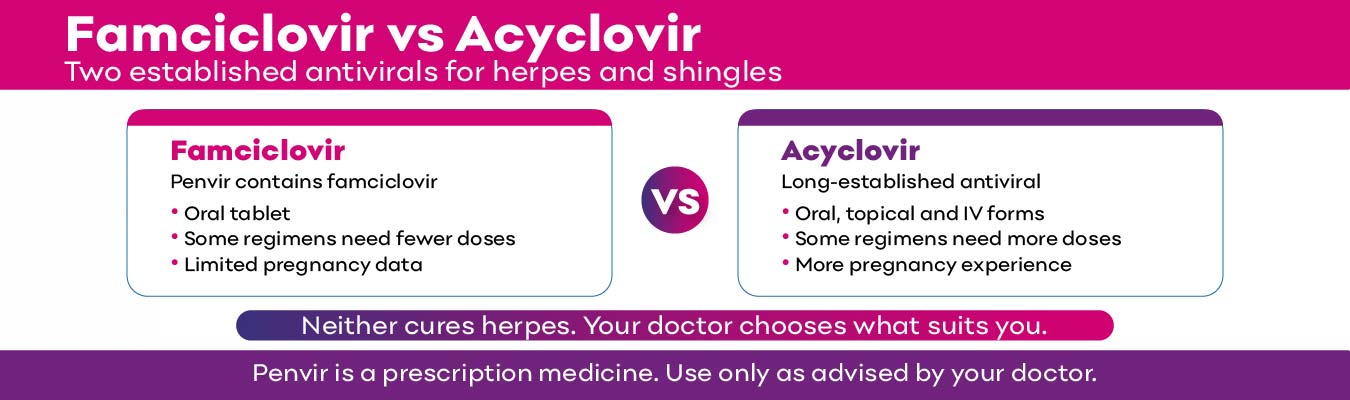
Famciclovir vs Acyclovir

Why does early treatment matter?

  • Antivirals work best when started early.
  • For shingles, treatment is generally most effective when started within 72 hours of the rash appearing.
  • For recurrent genital herpes, treatment works best when started during warning symptoms ( tingling, itching or burning) or within one day of lesions appearing.

What is herpes?

Several viruses belong to the herpesvirus family. Common examples include

  • Herpes simplex virus type 1 (HSV-1): commonly linked to cold sores, although it can also cause genital herpes.
  • Herpes simplex virus type 2 (HSV-2): commonly linked to genital herpes.
  • Varicella-zoster virus (VZV): causes chickenpox and can later reactivate as shingles (herpes zoster).

After infection, these viruses can remain inactive in nerve cells and reactivate later.

  • Antiviral treatment controls viral multiplication.
  • It does not remove the dormant virus from the body, so managing an outbreak is different from permanently curing the infection.

What is acyclovir?

Acyclovir (spelt aciclovir in the UK) is an established antiviral used for infections such as genital herpes, cold sores, shingles, chickenpox and certain herpes infections of the eye.

  • It is available in oral, topical and intravenous forms.
  • Intravenous acyclovir may be used in hospital for severe infections.
  • A cream, a tablet and an intravenous treatment are not interchangeable.
  • Inside infected cells, acyclovir is converted into an active form that interferes with viral DNA replication.

What is famciclovir, the active ingredient in Penvir?

Famciclovir is an oral antiviral that the body converts into penciclovir. Penciclovir is then activated inside infected cells, where it interferes with viral replication.

Penvir contains famciclovir and is used under medical supervision for appropriate herpesvirus infections, in line with its approved prescribing information. Depending on the diagnosis, famciclovir may be used for

  • Shingles (herpes zoster).
  • Recurrent genital herpes.
  • Suppression of recurrent genital herpes in selected patients.

Famciclovir is absorbed well when taken by mouth, which is one reason some famciclovir regimens involve fewer daily doses than some acyclovir regimens.

  • However, higher absorption does not by itself mean better outcomes, and the schedule always depends on the condition being treated.
  • If your doctor prescribes Penvir, follow the dose and duration you were given rather than comparing tablet counts with someone else's treatment.

What do famciclovir and acyclovir have in common?

Both medicines

  • Interfere with herpesvirus multiplication.
  • Can help manage outbreaks.
  • Work best when started early.
  • May be used for episodic treatment, and for suppressive treatment in selected patients.
  • Require consideration of kidney function.
  • Do not permanently eliminate the virus.

Neither medicine should be chosen because it is described as newer, stronger or more convenient.

Famciclovir vs acyclovir: key differences

Feature

Famciclovir (including Penvir)

Acyclovir

How it works

Converted into penciclovir, which is activated inside infected cells

Converted into its active form inside infected cells

Available forms

Oral tablets

Oral, topical and intravenous

Treatment schedule

Some regimens involve fewer daily doses or shorter courses

Some regimens need more frequent dosing

Recurrent genital herpes

Episodic treatment option

Episodic treatment option

Suppressive treatment

May be prescribed for selected patients

May be prescribed for selected patients

Shingles

Oral treatment option where appropriate

Oral treatment option where appropriate

Severe infections needing hospital care

Oral treatment may not be suitable

Intravenous treatment may be needed

Pregnancy

Available data are more limited

Greater clinical experience

Kidney impairment

Dose adjustment may be required

Dose adjustment may be required

These are general comparisons. They do not show that one medicine is superior to the other.

Which is better for recurrent genital herpes?

For episodic treatment of recurrent genital herpes, clinical guidance considers famciclovir and acyclovir similarly effective when used appropriately. Treatment works best when started during warning symptoms or within one day of lesions appearing.

The choice may depend on

  • The prescribed dosing schedule.
  • Previous treatment response.
  • Kidney function and other medicines.
  • Cost and availability.
  • Your doctor's assessment.

If Penvir is prescribed, ask when to start it, how long to take it and what to do if symptoms do not improve. A convenient schedule is useful, but it does not replace correct diagnosis or timely treatment.

Famciclovir vs acyclovir for shingles

Shingles occurs when the virus that caused chickenpox becomes active again. Common symptoms include

  • Pain, tingling or burning.
  • A blistering rash, usually on one side of the body.
  • Skin sensitivity and itching.
  • Headache or feeling unwell.

Famciclovir and acyclovir are both oral antiviral options for appropriate patients with shingles. Penvir may be prescribed when a doctor considers famciclovir suitable. Dosing frequency can differ between regimens, but fewer doses do not automatically mean greater effectiveness.

  • Seek medical advice promptly if you suspect shingles.
  • A rash involving the eye or nose, changes in vision, or a weakened immune system needs urgent assessment.
  • Do not wait to compare medicines online before getting help.

Does acyclovir's longer history make it better?

Not necessarily.

  • Acyclovir has a long record of clinical use and several formulations, which makes it useful in many settings.
  • Famciclovir offers an oral alternative with different dosing options.
  • The important question is not which medicine is older, but which treatment suits the infection and the patient.

Episodic vs suppressive herpes treatment

Episodic treatment means taking an antiviral when an outbreak begins.

  • Early warning signs include tingling, itching, burning or pain before sores appear.
  • People with recurrent outbreaks may be given a prescription and clear instructions so treatment can start promptly.
  • If Penvir forms part of your plan, confirm the start point and duration with your doctor.
  • Do not assume that a course prescribed for shingles suits a genital herpes recurrence.

Suppressive treatment means taking an antiviral regularly to reduce recurrent genital herpes episodes.

  • A doctor may discuss it when outbreaks are frequent, symptoms are severe or distressing, or recurrences affect daily life or relationships.
  • Famciclovir and acyclovir can both be used for suppression in appropriate patients, and the choice and duration need medical assessment.

Can antiviral treatment prevent herpes transmission?

  • No antiviral guarantees that herpes will not be passed to another person.
  • The virus can be present on the skin without visible sores, which is called asymptomatic viral shedding.
  • Controlling outbreaks, reducing viral shedding and reducing transmission are three separate outcomes, and guidelines note that antivirals differ in how well they suppress shedding.

Ways to lower the risk include

  • Avoiding sexual contact during an outbreak or warning symptoms.
  • Using condoms or other barriers correctly (they reduce risk but may not cover every affected area).
  • Telling sexual partners and discussing transmission concerns with your doctor.
  • Washing your hands after touching an affected area.

Taking Penvir does not remove the need for these precautions.

Side effects of famciclovir and acyclovir

Both medicines can cause side effects, although not everyone has them.

  • Famciclovir, including Penvir: headache, nausea, diarrhoea, dizziness and tiredness. Headache and nausea are among the most commonly reported.
  • Acyclovir: headache, nausea, diarrhoea, abdominal discomfort and dizziness.

Read the patient leaflet supplied with your medicine and discuss persistent or troublesome symptoms with your doctor.

  • Seek prompt medical advice for marked confusion, unusual drowsiness or reduced urination.
  • Difficulty breathing or swelling of the face, lips or tongue needs emergency care.

Why does kidney health matter?

  • Kidney function affects how the body clears both medicines.
  • When it is reduced, a doctor may need to adjust the dose or the gap between doses.
  • Prescribing information for famciclovir warns of acute kidney injury when people with kidney disease receive doses too high for their kidney function.

Before starting Penvir or another antiviral, tell your doctor if you

  • Have kidney disease or receive dialysis.
  • Have difficulty staying hydrated.
  • Take medicines that may affect the kidneys.

Follow any fluid advice you are given, and never increase the dose because symptoms seem more severe.

What about pregnancy and breastfeeding?

  • Do not start, stop or switch antiviral medicines during pregnancy or breastfeeding without medical advice.
  • Acyclovir has more pregnancy safety experience, while famciclovir has more limited pregnancy data.
  • If you are pregnant, planning a pregnancy or breastfeeding, tell your doctor so they can weigh the benefits and risks.
  • Genital herpes symptoms during pregnancy should be discussed promptly with your obstetrician or gynaecologist.

Can herpes become resistant to antivirals?

  • Resistance is uncommon in people with a healthy immune system but is a bigger concern when immunity is weakened.
  • Contact your doctor if sores are not improving, symptoms worsen during treatment, new lesions keep appearing, or outbreaks return despite correct treatment.
  • Some resistant viruses are resistant to more than one antiviral, so switching needs clinical advice.
  • If symptoms persist while taking Penvir, seek reassessment rather than extending the course or changing medicines yourself.

So, which antiviral is better?

  • There is no universal winner.
  • Acyclovir may suit when its formulations, long clinical experience, availability or cost fit the patient.
  • Famciclovir may suit when an oral regimen fits the diagnosis and the doctor considers its dosing schedule appropriate.
  • Penvir provides famciclovir as an oral tablet. Its role depends on the prescribed indication and the individual patient, not on a claim that it is stronger or better for everyone.

Questions to ask your doctor before you leave

  1. What infection am I being treated for?
  2. When should I start the medicine?
  3. What is the exact dose and duration?
  4. What should I do if I miss a dose?
  5. When should I return for review?

Frequently asked questions

Does Penvir cure herpes?

No. Penvir contains famciclovir, which helps control viral multiplication. It does not remove the dormant virus from the body.

Does acyclovir cure herpes?

No. Acyclovir helps control viral activity and symptoms, but the virus can remain dormant and reactivate later.

Is Penvir stronger than acyclovir?

"Stronger" is not a useful way to compare them. Treatment selection depends on the diagnosis, your clinical circumstances and the prescribed regimen.

Is famciclovir used for shingles in India?

Yes. Famciclovir is prescribed in India for shingles (herpes zoster) under the supervision of a healthcare professional.

Can I switch from acyclovir to Penvir myself?

No. Dose, frequency and duration differ by infection and medical need, so speak to your doctor before switching.

Can antivirals prevent shingles complications?

Starting treatment early may help reduce the severity of shingles. Your doctor can explain what to expect in your case.

Can I stop Penvir once the sores improve?

Take Penvir for the duration prescribed. Do not shorten, extend or repeat the course without medical advice.

Key takeaways

  • Famciclovir and acyclovir are established antivirals for appropriate herpesvirus infections, and neither cures herpes.
  • Penvir contains famciclovir and may be prescribed when it suits the diagnosis and the patient.
  • Early treatment matters, especially for shingles (within 72 hours of the rash) and for recurrent genital herpes.
  • Kidney function, pregnancy and other medicines affect the choice and dose.
  • Antivirals do not replace precautions to reduce transmission.

Conclusion

  • Correct diagnosis, timely treatment, appropriate dosing and follow-up matter more than choosing a medicine from a general comparison.
  • To find out whether Penvir is appropriate for you, speak to a qualified healthcare professional and use it only as prescribed.
  • Explore the Penvir website for further product information.

Medical disclaimer: This article is for educational purposes only and is not medical advice, diagnosis or treatment. Penvir is a prescription medicine. Always consult a qualified healthcare professional about medicines and treatment decisions.

References

Hello Aravind Useing Sticky Here

Hello Aravind Useing Sticky Here Testing scroll

Hello Aravind Useing Sticky Here Testing scroll

Hello Aravind Useing Sticky Here Testing scroll

Hello Aravind Useing Sticky Here Testing scroll

Hello Aravind Useing Sticky Here Testing scroll

Hello Aravind Useing Sticky Here Testing scroll

Hello Aravind Useing Sticky Here Testing scroll

Hello Aravind Useing Sticky Here Testing scroll

Hello Aravind Useing Sticky Here Testing scroll

Hello Aravind Useing Sticky Here Testing scroll

Hello Aravind Useing Sticky Here Testing scroll

Hello Aravind Useing Sticky Here Testing scroll

Hello Aravind Useing Sticky Here Testing scroll

Hello Aravind Useing Sticky Here Testing scroll

Hello Aravind Useing Sticky Here Testing scroll

Hello Aravind Useing Sticky Here Testing scroll

Hello Aravind Useing Sticky Here Testing scroll

Hello Aravind Useing Sticky Here Testing scroll

Hello Aravind Useing Sticky Here Testing scroll

Hello Aravind Useing Sticky Here Testing scroll

Hello Aravind Useing Sticky Here Testing scroll

Hello Aravind Useing Sticky Here Testing scroll

Hello Aravind Useing Sticky Here Testing scroll

Hello Aravind Useing Sticky Here Testing scroll

Hello Aravind Useing Sticky Here Testing scroll

Hello Aravind Useing Sticky Here Testing scroll

Hello Aravind Useing Sticky Here Testing scroll

Hello Aravind Useing Sticky Here Testing scroll

Hello Aravind Useing Sticky Here Testing scroll

Hello Aravind Useing Sticky Here Testing scroll